Audio Plugins
Studio magick requires spells. These plugins are what I use to create noise in the studio and tweeze my own recordings.
Grimoire Collection
Experimental audio plugins for Ableton.
Based on obscure eurorack modules and original organic concepts.
Optimized for modulation and variety of sounds.
MIDI Effects
- Fluxion - Curve-bent rhythm sequencer
Instruments
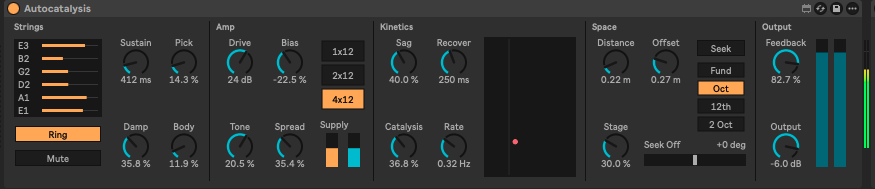
Autocatalysis means a product that speeds up its own production until it runs out of fuel. Amp feedback works the same way. The note excites the amp, the amp re-excites the strings, and it all grows until headroom runs out. So the dynamics engine models that literally: a fuel reservoir that the feedback burns and that refills over time. Everything else in the device is the physical loop that this engine sits inside.
Coagula is a concatenative instrument built around one long sample, up to about an hour. It analyzes the recording once into four segmentations with pitch, loudness, and timbre descriptors, and caches the result so it reloads instantly. For playback, you move a target around a scatter plot and it pulls up the closest-matching segments. Segments can chain continuously, follow a clock, or be played from MIDI across 32 voices.
Hypna is a five-voice drone instrument in just intonation. You choose a set of primes, and every voice's ratio snaps to the nearest one those primes can build. Each voice has its own gate, gain, and pan and plays from eight scannable wavetable banks. Retuning can slew or crossfade, and everything feeds a feedback-network reverb. The gates are switches, not notes, so it's meant to hang in the air.
Soma is a stereo oscillator trio and dual LPG meant for FM/PM exploration. Locking the ratios on the outside oscillators allows for perfectly tuned FM or they can be free running and modulated independently. The LPG has multiple settings and control for emulating vactrols and various materials.
Syzygy is three modal resonator bodies (wood, glass, and metal) coupled in a feedback field, so energy leaks between them. You can strike them, bow them, or let them evolve on their own. Raising coupling and instability pushes them from bell-like decays toward self-sustaining drones. It comes as an instrument and as an audio effect that uses your track as the exciter.
Vermiform
Inspired by ERD Worm
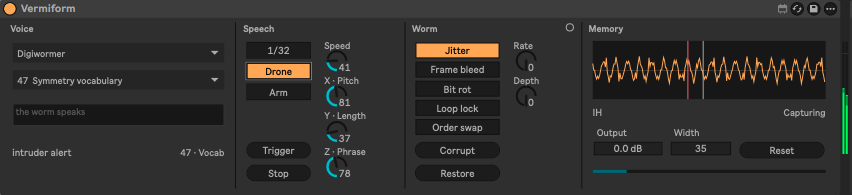
Vermiform is a mono speech synthesizer with seven voice families across 64 modes, from text-to-speech and phoneme lists to raw and circuit-bent chip voices. Its "worm" engine corrupts the speech data in real time with bit rot, frame bleed, loop lock, and reordered filter data. One button restores the clean speech. The last modes feed everything into a roughly 12-second ring buffer that you can loop and freeze.
Vril is a mono instrument with nine algorithms. Each pairs a sound generator (analog-style cross-mod, waveshaping pairs, sine clusters, or procedural wavetables) with its own Warp and Fuse modulation and one of two feedback delay processors. Both processors put a frequency shifter inside a four-line delay network, and they range from sparse echoes to diffuse tails with moving notches. You can also route in outside audio to run through the filter and processor.
Audio Effects
Atomism is a stereo granular effect built for glitch rather than texture. It tears 16 tiny grains (as short as 0.3 ms) out of a rolling 4-second buffer, with heavy pitch randomization. Grains can fire freely, in sync with tempo, on input transients, or from a chaos source. Every random value comes from one Entropy engine (noise, a logistic map, or a Lorenz attractor), so the chaos can settle, loop, or flip between states. Hold freezes the buffer, and Feedback writes the shredded output back into it.
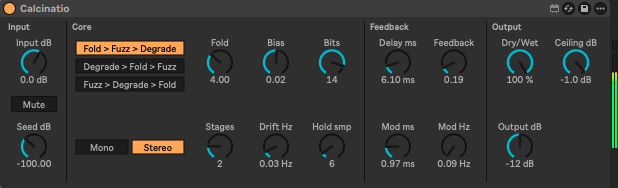
Calcinatio is a stereo harsh-noise effect. It runs input through a wavefolder, fuzz, and bit/sample-rate degrader in a selectable order, then into a short modulated comb delay with feedback. A continuous noise seed keeps it generating with no input, so it works as a processor or as a standalone feedback noise source. The output has a hard ceiling no matter how hard you drive it.
Chiasmus
Inspired by Count to 5
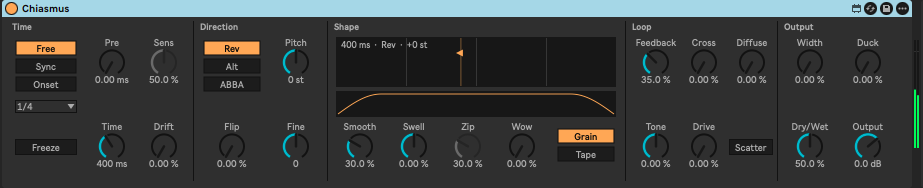
Chiasmus is a reverse delay with two engines. Grain uses six overlapping windowed voices. Tape uses one head that plays backwards, then physically stops and fast-forwards to catch up. Chunks can trigger freely, in sync with tempo, or on transients. The Cross control blends the feedback between a forward echo and the reversed output, so repeats can flip direction on every pass (A-B-B-A). It has zero latency, so you can treat it like a pedal.
Krisis consists of three saturating, inductor-style band-pass voices per channel with distortion inside the resonance loop, XYZ chaos modulation (Thomas / Chua) and wah / autowah. Set simply it passes for an inductor wah; pushed, it is a bank of coupled, self-oscillating resonators.
Materia is a Leibniz-style binary modular in one effect. It converts audio to 8-bit buses and runs them through a pool of digital modules: an oscillator, accumulators, bit masks, logic gates, lookup tables, shift registers, and a bit matrix. Two DACs turn the result back into audio. Routing is free, feedback included, so it covers everything from gentle bit mangling to self-clocking digital chaos. The full register state saves with the set, so a patch comes back exactly as you left it.
MIDI Effects
Fluxion
Inspired by IO Labs Flux
Fluxion is a 16-step MIDI rhythm generator. Each step splits into hits whose timing is bent by a drawable curve, which turns ratchets into accelerandos, drags, and lopsided clusters. Alongside the main note lane are two aux lanes that derive their own patterns from it. All 309 values, including every per-step setting, are Live parameters, so any of them can be automated or mapped to a modulator.